CIFAS markers are significant indicators that can impact your credit rating for up to six years. These markers hold the potential to disrupt various aspects of your financial life, potentially resulting in denied loan applications and closed accounts. Moreover, they can even hinder your chances of securing employment in certain sectors like the civil service and financial services industry.
In this guide, we’ll delve into what is a CIFAS marker, how they function, and the crucial steps to mitigate their effects on your financial and professional endeavours.
What is CIFAS?
The CIFAS stands for the Credit Industry Fraud Avoidance System (CIFAS), and it is a fraud prevention organisation that holds details of fraudulent activity across the UK. All financial organisations that hold a CIFAS membership can access their data. This system aims to enable organisations to reduce the risk of fraud and financial loss for themselves and other CIFAS members.
What is a CIFAS Marker?
The CIFAS place CIFAS makers against a customer’s credit report if an organisation suspects fraudulent activity. Other organisations can then access this information to gain information about the potential risks of lending money to this particular customer.
While there are different types of CIFAS markers, these warning flags will remain on a person’s record for approximately 6 years.
How Do I Know If I Have a CIFAS Marker?
If you’re concerned about whether you have a CIFAS marker, you can request a copy of your credit report from one of the UK’s credit reference agencies, such as Experian, Equifax, or TransUnion. Your credit report will typically include information about any CIFAS markers that have been placed on your file.
Additionally, if you believe you may be a victim of fraud, you can contact CIFAS directly to inquire about any markers associated with your identity. It’s essential to regularly monitor your credit report for any suspicious activity or markers to address any potential issues promptly.
The Different Types of CIFAS Markers
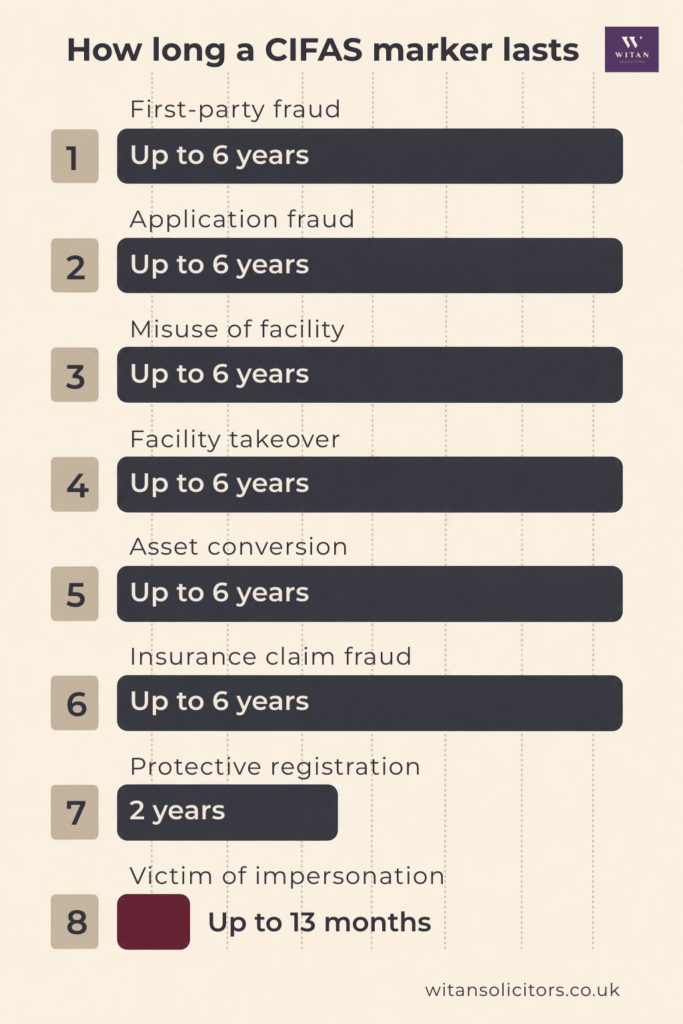
There are different types of CIFAS Markers, each lasting for various amounts of time:
- First-Party Fraud: This marker is applied when a customer fails to pay for goods or services they’ve received, with no intention of repayment, with a duration of up to 6 years.
- Insurance Claim Fraud: Applied when false or misleading information is provided during an insurance claim process, lasting for up to 6 years.
- Facility Takeover: Occurs when an unauthorised individual gains control of a bank account and conducts transactions without permission, with a duration of up to 6 years.
- Protective Registration: If you suspect you’ve been a victim of fraud, you can request CIFAS to place a marker on your file for added protection, lasting for 2 years.
- Victim of Impersonation: Filed by a lender when an individual has fallen victim to identity fraud, serving as a protective measure for up to 13 months.
- Application Fraud: This marker is set when a credit application is submitted with accurate personal information but false details, such as income or employment history, with a duration of up to 6 years.
- Asset Conversion: Applied when someone unlawfully sells goods that are under hire, rental, or lease agreements, like a hired vehicle, lasting for up to 6 years.
- Misuse of Facility: When an individual gains unauthorised access to another person’s account for fraudulent purposes, this marker is placed with a duration of up to 6 years.
The Consequences of CIFAS Markers
CIFAS markers can have severe financial repercussions for businesses and their directors. Instances include loan refusals, account closures, and loss of capital. Financial institutions may take action by closing accounts upon detecting CIFAS markers. Moreover, securing credit becomes increasingly challenging, affecting applications for mortgages, car insurance, overdrafts, and mobile phone contracts. Banks may reject new account applications, while obtaining student loans may also prove difficult, especially considering the student loan company’s CIFAS membership.
In worst-case scenarios, individuals working in the financial sector may lose their job role due to CIFAS markers.
Do CIFAS Markers Count Towards a Criminal Record?
It’s crucial to note that CIFAS markers themselves do not directly impact criminal records. However, if prosecutions arise from CIFAS-related misconduct, these legal proceedings could feature on one’s criminal record.
Can I Still Get a Bank Account with a CIFAS Marker?
The presence of CIFAS markers poses significant challenges in securing banking services. Financial institutions view these markers as indicators of potential fraud or money laundering risks, making it challenging to open accounts. Even obtaining accounts with overdraft facilities may prove problematic. To manage expectations, individuals are advised to discuss CIFAS markers with financial institutions before applying for accounts.
Do CIFAS Markers Make it Harder to Get Credit?
CIFAS markers serve as red flags to lenders, signalling a higher risk of fraudulent activity. Consequently, credit approval becomes more challenging, as financial institutions exercise caution in extending credit facilities to individuals with CIFAS markers.
Can Employers Become Aware of CIFAS Markers?
Employers may become aware of CIFAS markers through thorough background checks or when the nature of the job necessitates financial responsibility or security clearance. Hence, individuals should be aware of the potential implications of CIFAS markers on employment prospects.
I’ve Got a CIFAS Marker, Can It Be Removed?
Yes, you can challenge a CIFAS marker.
To identify if you have a CIFAS marker you can check on your credit file via websites that provide credit reports. This will give you details of the matter such as the reference and who has placed the marker (CIFAS or the institution). You can contact CIFAS through email or complaint request. This can take up to 30 days.
Removing a CIFAS Marker
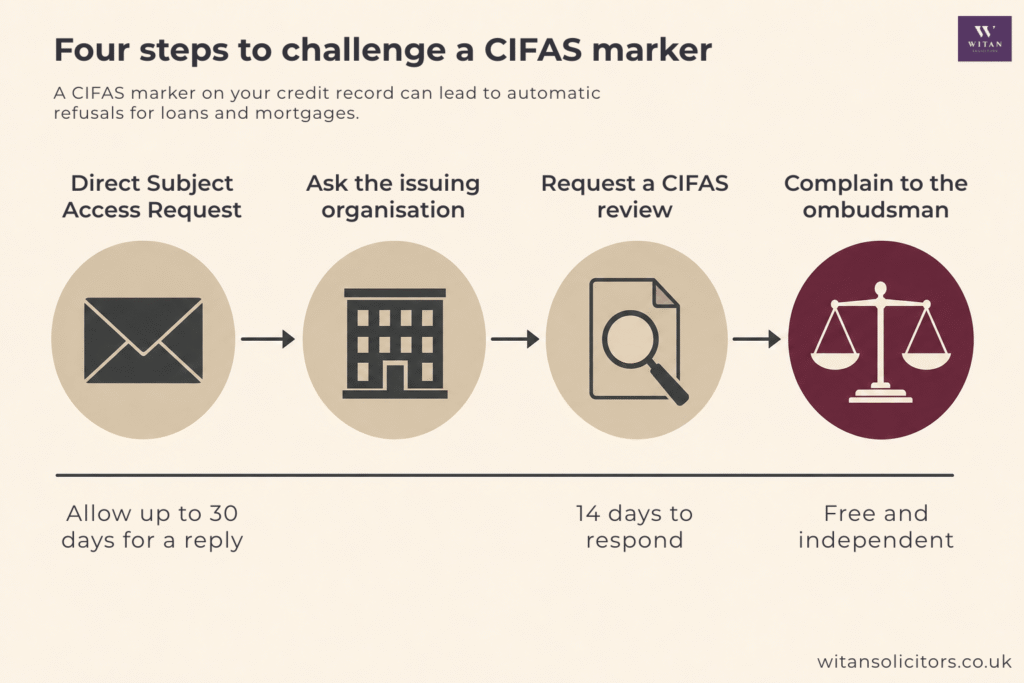
The following steps explain the steps to removing the CIFAS marker.
Step 1: Request a CIFAS Letter by making a Direct Subject Access Request requesting CIFAS to set out the details of the marker(s) that CIFAS hold on their database. Often they will also disclose the type of conduct of the financial crime.
Step 2: Contact the organisation that has issued the marker and request removal.
Step 3: Request CIFAS Review if the request to have the marker removed is denied by the institution who placed it. CIFAS must respond in 14 days.
Step 4: Should CIFAS uphold the institution’s decision, refusing to remove the marker, you can then raise a complaint to the ombudsman or relevant complaint service.
How Witan Solicitors Can Help
For more assistance regarding CIFAS markers or other fraud databases (such as Synectic Solutions SIRA and National Hunter), please contact us. Our lawyers can assist you and provide legal advice on CIFAS marker matters and how they impact you and your business. As well as support throughout the steps to challenge the CIFAS Matter on your behalf providing good legal advice, strategy, and resolution. Please get in touch to discuss your situation today.