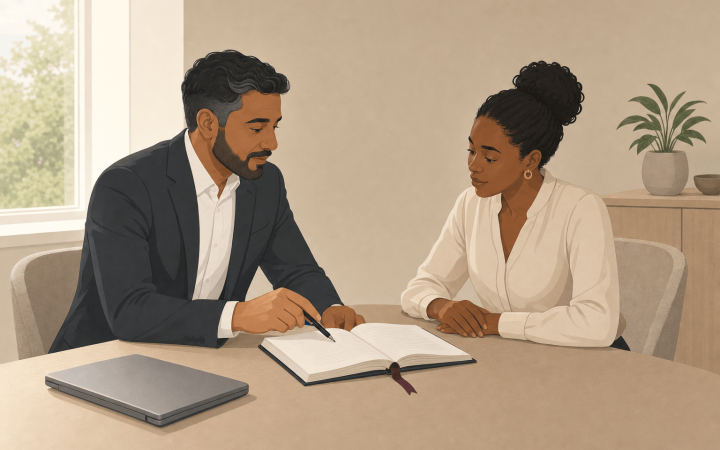
If you are dealing with the breakdown of a relationship and you want to divorce, you have the choice of making a sole divorce application or a joint application with your spouse. We answer the question, What is a sole divorce application? And look at what else you need to take into account when going through the divorce process.
Joint and Sole Divorce Applications
In April 2022, divorce law changed to eliminate the need to explain why a relationship had ended. In an attempt to stop the apportioning of blame, the new law only requires the statement that the relationship has irretrievably broken down, with no other information necessary.
It also became possible for a couple to apply for a divorce together by making a joint application, although most divorces are dealt with after a sole divorce application.
Why Choose a Sole Divorce Application?
If you choose to make a sole divorce application, you will not have to rely on your spouse to work with you to fill in the forms and sign the documents. Even if you start with a joint application, if your spouse stops cooperating you can switch to an individual basis and deal with matters on your own if you need to.
Divorce solicitors do not generally assist with joint applications because of the conflict of interest.
It is also usually best to choose a sole application if there is any abuse or your spouse is likely to be difficult during the divorce or separation process.
Changing from a joint to a sole divorce application will cause a delay of two weeks or so, as your spouse will need to be served with notice of the change if it occurs when an application for a final order is made.
The Sole Divorce Application Process
The divorce process starts with the completion of form D8, an application for divorce or dissolution (ending a civil partnership) or by filling in an online version of the form.
Once you have done this, it is submitted to the court with the court fee and your marriage or civil partnership certificate or a certified copy. The court will then send a copy of your application to your spouse and confirm to you that this has been done. You will be provided with a case number and a stamped copy of your application.
Your spouse will have 14 days to respond to the court with an acknowledgement of service confirming that they have received the copy application.
They will normally agree with the divorce, although there are some limited circumstances in which a divorce can be disputed, namely when the marriage is not valid or the court does not have the authority to hear the case because of where the marriage took place.
It is not possible to dispute a divorce simply because someone does not want it to happen.
The next stage is to ask the court for a conditional order for divorce. You can do this even if your spouse has not responded to your application. The earliest you can apply for a conditional order is 20 weeks after the court issues your divorce application.
The court will review your application, which could take several weeks. You will then be granted a conditional order. You need to wait a further six weeks and one day from the date of the conditional order and you can then apply for a final order.
When the final order is issued, you are divorced.
What Should You Do Before Applying for a Divorce?
It is essential to have a financial order in place if you are divorcing. This is normally finalised before the final order is obtained.
The reason you need a financial order is that without one, you would still have a financial responsibility to your spouse as this is not ended by divorce alone.
A financial order sets out how assets and liabilities will be divided, including property and pensions, and whether any ongoing maintenance payments will be made.
You should speak to a divorce solicitor to ensure that your rights are safeguarded when dealing with financial matters. Even if you and your spouse can agree on how you want matters dealt with, a solicitor will be able to draft an order for the court to approve and seal.
You may also want to agree on arrangements for your children and have these put into a binding child arrangements order.
Contact Our Divorce Solicitors
If you need advice on obtaining a divorce or dealing with related matters such as issues relating to finances, property or children, we will do all we can to help.
For more information on our services, see our family law and divorce page.
To speak to one of our expert divorce solicitors, ring us on 0300 303 2071, email us at info@witansolicitors.co.uk or fill in our contact form and we will talk through your situation with you and discuss how we can assist.